Microarray analysis for non-coders using sMAP
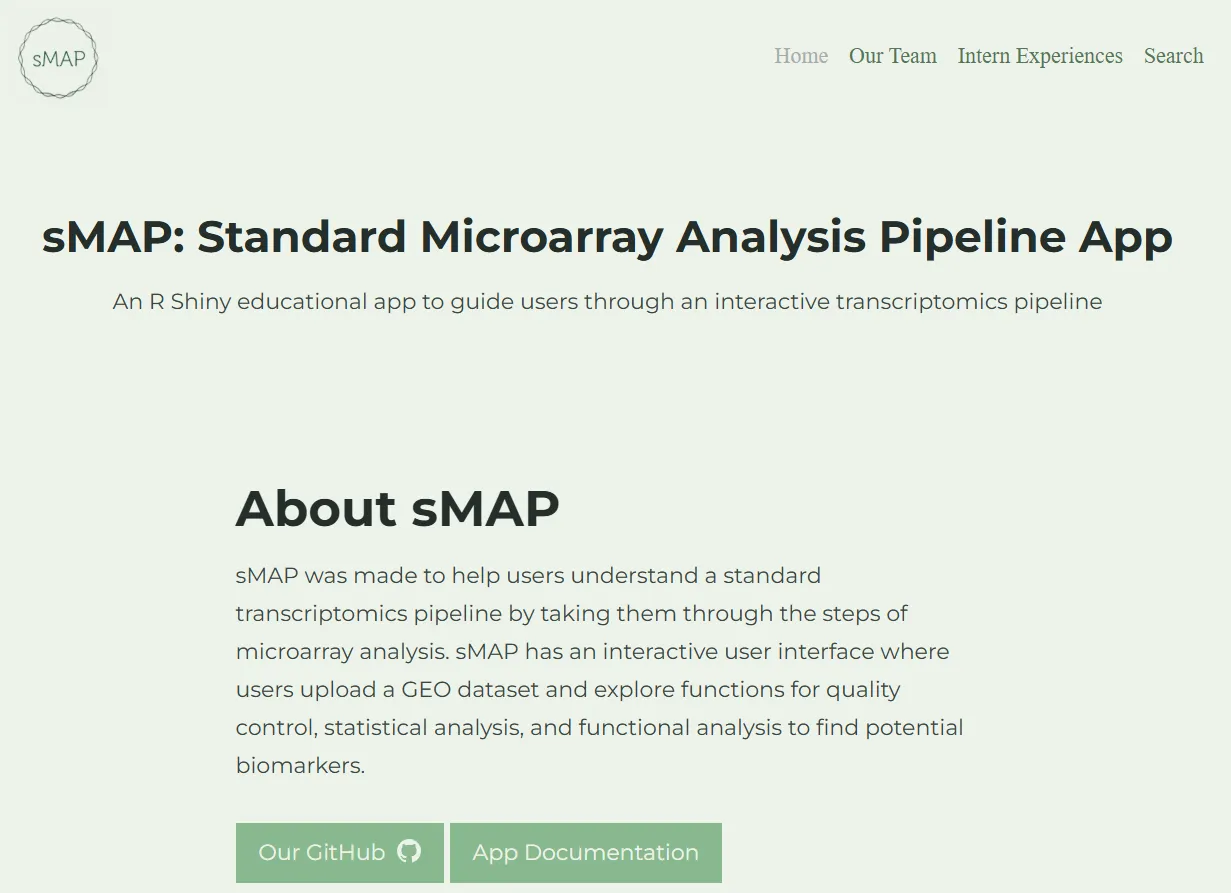
An R Shiny application enabling researchers to analyze microarray datasets.
RNA sequencing now dominates transcriptomics, but microarrays were its backbone for years, and a huge amount of valuable data was generated with them. They still have their uses. Analyzing that data, legacy or new, usually takes bioinformatics expertise and coding skills that many bench scientists, students, and researchers do not have. How can we make these analyses more accessible?
That question led to sMAP (Standard Microarray Analysis Pipeline), an educational project developed during my internship with STEM-Away. The goal was to build an interactive R Shiny tool that guides people without coding experience through a complete microarray analysis workflow: loading raw data files, exploring differentially expressed genes, and visualizing results.
Building sMAP: A Global Collaboration
#sMAP was built by a team of more than 40 international participants: high school students, university students, and junior professionals. Together we brainstormed, designed, coded, and tested the application. The project was as much about giving everyone real, hands-on software development experience as it was about the tool itself.
My Role in Our Team Effort
#My role was to steer the technical development of the R Shiny application. This involved guiding the group in translating standard microarray analysis steps (like data normalization, quality control, differential expression analysis using limma, and various plotting methods) into an intuitive web interface. It also meant coordinating the diverse contributions from team members across different time zones and ensuring we collectively moved towards our shared goal.
Why sMAP Mattered (and Still Does Conceptually)
#Tools like sMAP aim to lower the barrier to entry for biological data analysis. By wrapping complex command-line procedures in a graphical interface, the project sought to:
-
Empower Non-Coders: Enable researchers and students to analyze microarray data confidently without needing to write R code.
-
Educate: Act as an interactive guide, helping users understand the workflow and principles behind microarray analysis.
-
Promote Accessibility: Make essential bioinformatics techniques more readily available to the broader life sciences community working with this important data type.
Project Resources
#While the hosted instance of the app might not be active anymore, the project remains a good example of collaborative tool-building:
-
Learn more about the project: https://bi-stem-away.github.io/sMAP/
-
Explore the code on GitHub: https://github.com/BI-STEM-Away/sMAP
-
Read our preprint: Bharti, Krishnan, Veyssi, Momeni, Raj (2022). bioRxiv. https://doi.org/10.1101/2022.05.27.492984
sMAP taught me a lot about teamwork, and about how much demand there is for tools that make complex analysis accessible.